Facebook forever: expanding mobile features to include everything

This post is part of the Facebook forever series, on Facebook’s plan to outlast the web on mobile.
Until as recently as last year, Mark Zuckerberg thought of Facebook as a web company. Now, he says, mobile is the company’s “big focus” moving forward. In this series, we’ll examine Facebook’s strategic positioning to become a conglomeration of great mobile experiences, offer a wealth of features to displace competitors, and build a next-generation mobile platform designed to replace the web.
Like many mobile giants, Facebook wants to be an integral part of as many of your mobile experiences as possible. They’re looking to increase their presence on your phone not only through strategic acquisitions and conglomeration, but also by reducing the number of apps you need to accomplish any task. Facebook is looking to increase the functionality and usefulness of their mobile offerings so that users will need fewer and fewer icons on their home screens—and the remaining icons are made by Facebook.
Apps with more features
For Facebook’s mobile apps, like those of many other web-first companies, the challenge has always been achieving feature parity with the fast-moving web interface. In years past, once a feature was added to the web interface, it would be weeks or more before a matching feature made its way to their smartphone apps. But as Facebook has evolved and iterated their mobile applications, they’ve moved past the point of parity and are now building mobile-exclusive features and experiences that highlight the company’s new focus.
Facebook’s newest mobile features transcend feature parity with the web interface.
The iPhone and Android mobile apps have seen several new capabilities added to the “More” tab in recent months, including a new way to find and meet up with friends based on their locations and even a new way to “Save” items like articles, restaurants, and TV shows to review later. Similar to read-it-later apps like Pocket or Instapaper, the new feature is designed to help users feel less overwhelmed by the volume of content in their News Feed and allow them to digest the links and pages at a more convenient time or on another device. This news comes just over two years after Facebook acquired read-it-later startup Spool, which offered a Chrome extension and iOS app until 2012. Interestingly, the Save button isn’t currently available in Facebook’s news and reading iOS app, Paper.
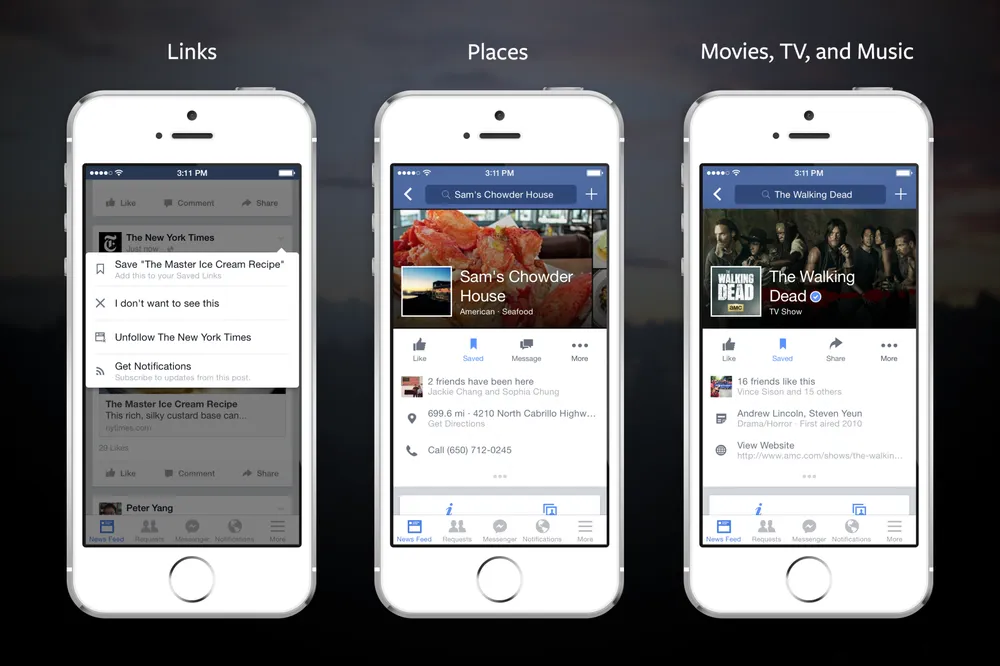
Since Facebook users spend much of their online time reading through their News Feeds, this new Save feature could see widespread adoption and use—perhaps more than competing services like Instapaper and Pocket. The goal is to minimize the number of times a user would need to open a non-Facebook app, so Facebook is committed to covering as many bases as possible. Other new initiatives include a media recognition service built into the status editor that directly competes with existing services like SoundHound and Shazam, as well as a Deals platform that allows restaurants and businesses to offer time and location-sensitive offers to customers, much like Groupon or Yelp.
Along similar ecommerce lines, Facebook has been testing a new “Buy” button that allows Pages and advertisers to offer products to Facebook users on mobile. In the future, this rudimentary ecommerce platform could grow to compete with the likes of Amazon and other online retailers, as Facebook’s command of user attention gives these product listings unmatched opportunities for visibility and engagement.
Features with more apps
Besides the development of tablet versions and the steady match toward feature parity with their web interface, Facebook has begun splicing their branded app’s core services into a handful of single-purpose apps. Messenger combined Facebook Chat and so-called “Inbox” messages in 2011, and represented a departure from their previous one-app-to-rule-them-all model. Now, users could chat with their Facebook friends without ever downloading the main Facebook app — and people loved it. Since then, Facebook has dabbled with single-purpose brand app endeavors like Snapchat clone Facebook Poke and photos client Facebook Camera, but none have seen the attention from both the public and from Facebook’s developers that Messenger has enjoyed.
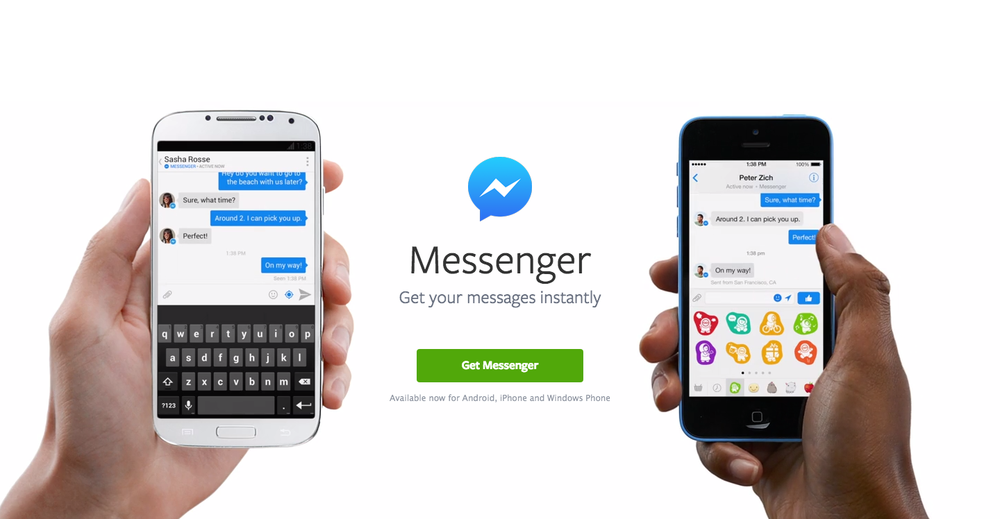
Messenger is billed as “free texting from Facebook.”
Messenger is a prime example of Facebook’s aim to displace core functions of your smartphone with their proprietary services. On Messenger’s product page on Facebook, the company labels it “Free texting from Facebook,” despite the fact that Facebook messages are more similar to XMPP chat services like AOL Instant Messenger and the sunsetting Google Talk than they are to SMS messaging. But the intent is for Facebook Messenger to fill that particular need for users, and to replace the need for stock SMS or MMS messaging application on their smartphones. (In 2012, Facebook Messenger for Android could even be set as the phone’s default SMS message handler, a feature that has since been dropped as Google delivered Hangouts in recent versions of Android.) Messenger even features a simple contact manager separate from Facebook members’ friends list, meaning users can add phone numbers to communicate with on Messenger without even sending a Facebook friend request. By offering unique features like Stickers, Chat Heads, and a one-tap selfie button, Messenger aims to replace users’ desire to send SMS or other messages altogether.
By offering unique features like Stickers, Chat Heads, and a one-tap selfie button, Messenger aims to replace the desire to send SMS messages altogether.
As Facebook splices up its mobile offerings into more and more single-purpose or targeted apps, it becomes increasingly easy to replace many of your smartphone’s functions with complementary Facebook solutions. When everything you want to do can be done with a Facebook app or service, the company is closer to achieving their goal of building their own cohesive mobile platform. In part 3, we’ll examine the building blocks of Facebook’s next chapter—a mobile and wearable platform that could replace the web altogether.
Posts mentioning this one
- How bots fit into your app’s UX
- How apps can use iOS 10’s Messages SDK to join the conversation
- Facebook M, Samsung Pay, iPhone 6s is coming
- Apple Watch launch, Google Fi, Facebook Hello
- Meerkat, Windows 10, Nintendo
- What the “app unbundling” mobile strategy means for consumer brands
- Facebook Lite shows how data impacts mobile-first app design
- Mobile Marketing Trends of 2015
- Nexus 6, Android Lollipop, iMessage
- iMessage evolves beyond the text message
- Facebook forever: mobile and wearable platforms to replace the web
- Facebook forever: assimilating every great mobile experience
- What does Foursquare’s two-app strategy mean for mobile?